

【T&M In-Depth】5G NTN Testing: Simulating LEO Satellite Doppler & Latency
Updated: Jan 25
Without This Test, Next-Generation Technology Stalls
Imagine trying to hold a phone conversation with a cell tower hundreds of kilometers away. The catch? This tower (a Low Earth Orbit satellite) is racing across the sky at 20 times the speed of sound. It’s like two people standing on top of high-speed trains moving in opposite directions, trying to play catch with a baseball (data packets). If the throwing angle (antenna beam) is off by a fraction of a degree, or if the players can't see each other clearly due to the extreme relative speed (Doppler shift), the connection breaks instantly.
The core mission of 5G NTN testing is to recreate this "Mach 20" environment inside a ground-based laboratory. Using precision instruments to simulate the frequency drift and massive delays caused by moving satellites, engineers ensure your phone chip can "predict" and "correct" these extreme physical phenomena. Without this test, the "Direct-to-Cell" feature on your phone would remain forever stuck on "Searching for Signal..."

The Technology Explained: Principles and Unprecedented Challenges
Yesterday's Bottleneck: Why Traditional Methods Are No Longer Sufficient
In traditional Terrestrial Networks (TN), base stations are stationary, or at most, the user is moving at highway speeds. Test engineers primarily focused on signal fading caused by building obstructions.
However, when shifting to Non-Terrestrial Networks (NTN), the laws of physics change drastically:
Violent Doppler Effect:
Just as an ambulance siren sounds higher as it approaches and lower as it passes, when a satellite approaches and recedes from a phone at 7.6 km/s, the radio wave frequency shifts dramatically (up to tens of kHz). A traditional 5G chip, without special design and testing, would fail to lock onto this "out-of-tune" signal entirely.

Unpredictable, Time-Varying Latency:
Signal delay from a ground tower is microseconds and relatively fixed. But satellite signals take milliseconds (LEO) or hundreds of milliseconds (GEO) to travel the round trip. Worse, as the satellite moves, this delay is dynamically changing. The phone must calculate and compensate for this shifting time difference in real-time; otherwise, upload packets will arrive at the wrong time, causing collisions.

Massive Path Loss:
Signals must traverse hundreds of kilometers of vacuum and atmosphere, resulting in immense energy loss. This pushes the phone's transmit power and receiver sensitivity to their absolute limits.

What Are the Core Principles of the Test?
To verify these challenges without launching actual satellites, the T&M industry's ultimate weapon is the "Channel Emulator." The principle is to build a "digital twin" of the space environment:
Modeling the Orbit: First, real satellite orbital parameters (altitude, velocity, inclination) are input into the test software. The software calculates the relative position, speed, and distance between the satellite and the ground terminal (UE) at any given millisecond.
Real-Time Signal "Warping": A Network Emulator generates a standard 5G signal. This signal is fed into the Channel Emulator, which acts as a "special effects artist." It applies precise Doppler shifts, dynamic delays, and path losses to the signal in real-time, matching the calculated orbital model.
Closed-Loop Validation: The "warped" signal is sent to the DUT chip. The chip must demonstrate its algorithmic ability to compensate for the frequency offset and timing error, successfully completing the handshake and data transfer. If the chip can maintain a stable call in this virtual space, only then is it ready for the real world.

The Breakthrough of the New Generation of Test
Full-Stack Emulation: Past testing might have only checked the RF layer. But in NTN, the massive latency affects upper-layer protocols (like HARQ retransmission). New solutions must integrate RF channel emulation with protocol stack emulation to verify that the protocol layer doesn't "timeout" due to the long delays.
Dynamic 3D Scenario Modeling: Advanced tools support importing orbit data from professional aerospace software like STK. They can recreate complex scenarios like "Satellite Handover"—testing how a phone smoothly switches connection from a setting satellite to a rising one without dropping the call.
High Dynamic Range RF Front-End: To simulate faint signals from space, the test instrument's RF front-end must have an extreme dynamic range, capable of generating signals down to -120 dBm while maintaining an ultra-low noise floor.

Industry Impact & Applications
The Complete Validation Blueprint: From R&D to Mass Production
Challenge 1: Chip-Level Waveform & Protocol Validation
Chip designers (e.g., MediaTek, Qualcomm) must verify that their 5G NTN modem algorithms can handle frequency offsets up to 40 ppm and perform dynamic timing compensation.
Core Test Tools and Technical Requirements:
5G Network Emulator paired with a High-End Channel Emulator (e.g., Keysight PROPSIM or R&S CMX500+SMBV).
The key capability is Real-time Simulation: The instrument must continuously vary the frequency and delay based on the orbit model, simulating a full 10-15 minute satellite pass without interruption.

Challenge 2: User Equipment (UE) System Performance
Phone manufacturers need to verify antenna design and thermal management. Since satellite signals are weak, phones must transmit at max power, causing heat and battery drain issues.
Core Test Tools and Technical Requirements:
OTA (Over-The-Air) Chamber: Testing the entire phone inside an isolation chamber wirelessly.
Dynamic Link Budget Analysis: The instrument records the phone's Tx Power and Throughput changes during the simulated satellite pass to ensure the call doesn't drop due to handshake failures.

Challenge 3: Satellite Payload Verification
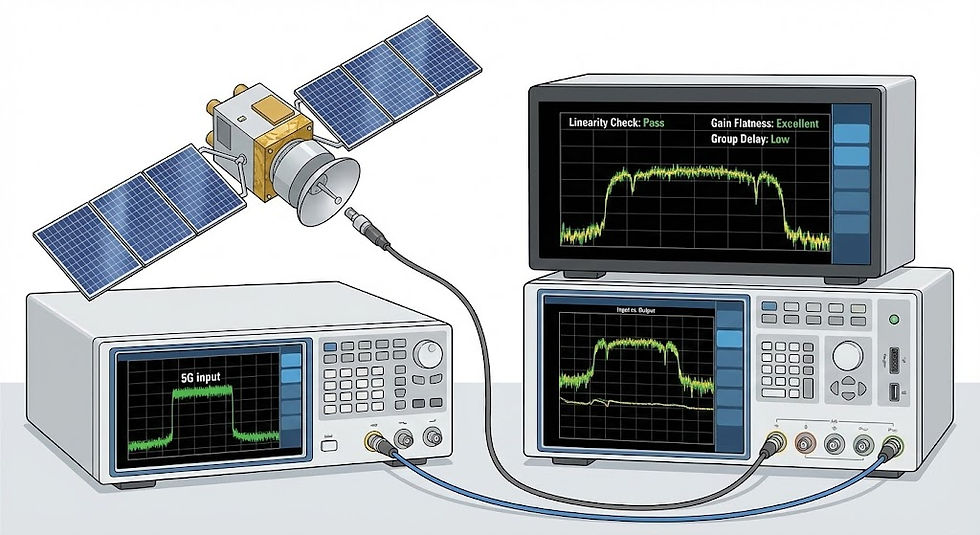
For satellite makers (e.g., SpaceX, OneWeb), the communication payload on the satellite must be verified to correctly relay 5G signals (transparent mode).
Core Test Tools and Technical Requirements:
Vector Signal Generator (VSG) and Signal Analyzer (VSA). The focus here is on the linearity, gain flatness, and group delay of the transponder. Since the satellite acts as a mirror, it must reflect the signal back to Earth without distortion.
King of Applications: Which Industries Depend on It?
5G NTN test technology bridges the "Space Industry" and the "Telecom Industry":
Smartphone Chips & OEMs: MediaTek is a frontrunner in NTN technology, having successfully demonstrated 2-way satellite comms via testing. Apple and Huawei have made satellite connectivity a standard flagship feature.
LEO Satellite Operators: Starlink, OneWeb, and Amazon Kuiper are deploying thousands of satellites. Every satellite module and ground gateway requires rigorous NTN standard testing.
IoT: For tracking containers, ocean buoys, and smart agriculture where cell towers don't exist, NB-IoT over NTN provides a truly global coverage solution.
The Road Ahead: Adoption Challenges and the Next Wave
A current challenge is Beam Switching & Interference Management. Future satellites will use multiple Spot Beams. Testing how a phone maintains a connection while switching between these rapidly moving beams is a new hurdle. The next trend is Regenerative Payload testing. Future satellites won't just be mirrors; they will be "Flying Base Stations" with full processing power. This means test instruments must simulate complex Inter-Satellite Links (ISL) and edge computing scenarios in space.
An Investor's Perspective: Why the "Shovel-Selling" Business Merits Attention
The Space Economy is on the verge of explosion. As Elon Musk and Jeff Bezos race to launch rockets, they are creating a new dimension of connectivity. However, there are no repair shops in space. Once a satellite is launched, any communication failure is an irreversible disaster.
The T&M companies providing NTN solutions hold unique value:
High Barrier to Entry: The technology to perfectly blend orbital mechanics (physics) with 5G protocols (electronics) creates a massive technical moat. Only a few players (Keysight, R&S, Anritsu) can execute this well.
Driving Standardization: The 3GPP NTN standards are still evolving (Rel-18, Rel-19). T&M vendors are deeply involved in defining these standards, making their equipment the reference for compliance.
Geopolitical & Defense Demand: Beyond commercial use, NTN is critical for defense communications. This ensures a rigid demand for these test solutions from government and defense sectors.
Investing in NTN testing is investing in a future of "Global Ubiquity." When 5G signals rain down from the sky, the invisible threads that ensure they don't break are spun by these precision ground-based instruments.
Aminext spent a lot of time researching and putting this article together... If you found it helpful, maybe... maybe you could give it a 'like' or share it with a friend who might need it? Every little bit of your support is the biggest motivation for me to keep tracking the latest tech trends for everyone!


Comments